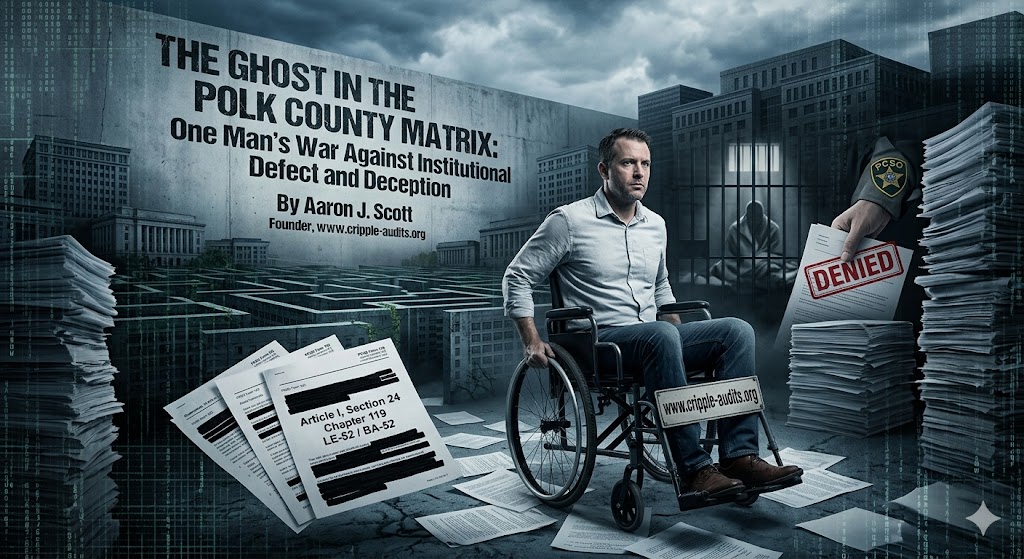
By Aaron J. Scott
Founder, www.cripple-audits.org
INTRODUCTION: THE ANATOMY OF AN UNLAWFUL CAPTURE
In the state of Florida, government transparency is not a statutory courtesy; it is a foundational constitutional mandate. Under Article I, Section 24 of the Florida Constitution, every citizen possesses an unassailable right to inspect and copy any public record generated by an agency of the state. This constitutional canopy is reinforced by Chapter 119 of the Florida Statutes—the Public Records Act—which mandates that custodians of public records must permit inspection at any reasonable time, under reasonable conditions, and complete their production in good faith.
Yet, within the jurisdictional boundaries of Polk County, Florida, the rule of law has been supplanted by an insular administrative apparatus. What began on August 8, 2024, as an uncorroborated, hearsay-driven residential dispatch has escalated into a multi-front judicial warfare. It is an expose of institutional non-compliance, bad-faith legal maneuvering, and a coordinated campaign by public officials to insulate themselves from accountability by weaponizing redacting markers, administrative labels, and procedural stays.
This is the investigative chronicle of an active litigation—Aaron J. Scott v. Polk County Sheriff’s Office, et al. (Case No. 2025CA003499)—and the parallel appellate and tort actions that have unmasked a profound structural defect inside the Polk County Sheriff’s Office (PCSO).
SECTION 1: THE USE OF FORCE IN THE OPEN FIELD
On the afternoon of August 8, 2024, units from the Polk County Sheriff’s Office descended upon the residence of Aaron J. Scott. The dispatch was initiated by a third-party social worker who alleged that Scott was experiencing a bipolar crisis and threatening self-harm. Scott, a wheelchair-dependent individual with a documented Traumatic Brain Injury affecting his short-term memory, was met outside his threshold by Deputy Dustin Wade.
With his hands extended and completely visible, Scott immediately engaged in protective disclosure, informing Deputy Wade that a legally owned firearm was affixed to his wheelchair chassis. This encounter occurred as Scott and the deputy were calmly talking. After Deputy Wade stated, “I am going to reach in and secure your Firearm,” Scott loudly protested: “No you’re not, don’t come in my home, don’t touch my property.” Wade drew his service weapon immediately after Scott loudly protested, despite Scott keeping his hands fully visible and offering absolutely no physical resistance.
This initial point of contact triggered the first cascade of strict internal agency policy violations:
- The Deadly Force Display Question: Under PCSO General Order 1.5 (Protective Action / Response to Resistance), drawing a lethal weapon to compel compliance from a non-mobile, non-threatening subject constitutes a high-liability display of force. Policy strictly mandates that the deploying member must generate an independent Protective Action Report to articulate the objective necessity of that threat. We do not currently know if a Protective Action Report was ever actually authored by the agency; we only know that it was completely withheld and omitted from the records provided in response to Scott’s Chapter 119 records requests.
- The Supplemental Report Gap: Under General Order 13.1 (Incident Reporting), every backup unit performing a physical task on a scene must file an individual Supplemental Report. Upon his arrival at the scene, Master Deputy Covietz immediately dismissed Wade, ordering him to depart the area by stating, “You can go. I’m not dealing with you today.” While the exact motivation behind Covietz’s sudden dismissal of Wade remains unknown, the entirety of this critical interaction was captured clearly on Scott’s Roku doorbell camera video. Wade and multiple backup units exited the scene leaving a complete void of documentation—an absence of files that was only uncovered when the records requests came back empty.
As the scene progressed, an even more severe breach occurred. While no detective ever arrived on scene, and Detective Kristina Fitzgerald was never physically present, Sergeant Timothy Lynch executed an unauthorized electronic intercept. Lynch deliberately left an active phone line open to Detective Fitzgerald, allowing her to secretly overhear and broadcast an oral conversation occurring within the open field next to Scott’s home.
The Statutory Infraction: This off-the-record eavesdropping maneuver stands as a flagrant breach of PCSO DLE Directive 200.51 (Emergency Interception of Communications) and constitutes a potential felony under Section 934.03, Florida Statutes (Florida’s strict two-party wiretapping consent law). As with the force paperwork, it remains an open question whether an emergency interception log was ever authored behind closed doors; the tactical reality is that it was systematically hidden from the public records disclosure. This raises a deeper systemic question: Does PCSO maintain an unwritten policy mandating that any public records request submitted by a citizen engaged in active litigation against the agency be stripped from the normal records bureau pipeline and handled exclusively by Legal Affairs to control the narrative?
SECTION 2: ARBITRARY CRUELTY BEHIND CLOSED DOORS
Following his physical extraction from the scene, Scott was transported directly to the Sheriff’s Processing Center. At this stage of the timeline, he had been provided absolutely no reports or charging documents by the agency. While he explicitly requested the statutory LE-52/BA-52 Baker Act commitment forms through Chapter 119, the agency failed to produce them. Consequently, there is zero verifiable evidence to support the assertion that a legitimate Baker Act form was ever legally executed at the scene.
Instead, the severe deprivations began immediately at the processing terminal before Scott was ever moved to the South County Jail facility:
- The Medical Compression Sock Denial: Scott was wearing a medically necessary compression sock required to manage chronic swelling and pain. Processing center deputies referred the decision to jail nursing staff to determine medical necessity. The medical personnel simply looked at the garment and declared, “It’s black, he can’t have it.” When Scott asked, “Even if it is medically necessary?” the staff repeated in unison, “No, it’s black, you can’t have it, we only allow white socks.” Enforcing arbitrary uniform color codes over basic healthcare access, they stripped the device from his limb.
- The Short-Term CSU Isolation: Scott was briefly routed to the Peace River Center Crisis Stabilization Unit (CSU). Following a rapid evaluation, the Medical Director/Attending Psychiatrist determined that Scott did not pose an imminent risk to himself or others, immediately issuing a formal clinical discharge.
What followed his transfer back into the custody of the South County Jail medical unit exposes the absolute failure of the jail’s custodial system. Following his introduction to the medical wing, Scott was taken before a judge for his First Appearance hearing. Recognizing the deficiency of the state’s initial position, Judge Keith Spoto issued a formal bond allowing for his release. Immediately, a friend of Scott’s arrived at the jail with a bondsman to post the cash and secure his freedom. However, the bondsman was abruptly turned away and informed by detention staff that an administrative “hold” had been placed on Scott. Despite a signed judicial order granting a bond, Scott’s physical release was completely barred and overridden by the agency’s internal hold.
Under this blanket administrative rule, Scott was stripped of his prosthetic device and left completely naked with only two blankets—one to lay on and one to cover himself with. For days, an apathetic dayshift staff denied him access to a wheelchair, forcing a naked, disabled citizen to crawl across a bare floor to reach the toilet directly under the lens of a security camera.
Jail logs confirm that an interview did take place on the morning of August 11, 2024. In fact, YesCare subsequently produced an internal log from DLE Deputy Light, explicitly documenting that she was physically escorting LMHC Megan Renz and was present to witness that an evaluation did in fact occur. However, the operational reality is that staff never actually entered the cell; the entire clinical interview was conducted talking through the cell door, and the absolute raw text of Megan Renz’s clinical note has been completely withheld or erased from the production.
SECTION 3: THE GENESIS OF DECEPTION—A TALE OF TWO SUITS
The state’s ability to maintain this false narrative was directly facilitated by a complete breakdown in professional legal advocacy, stretching across two entirely separate legal actors.
First, Scott’s defense was completely derailed by his hired counsel, Ben Stechschulte, Esq., of the law firm Stechschulte Nell, who was retained to handle both the RPO and the primary criminal case. Before the RPO hearing could even take place, Scott’s mother executed a formal waiver of prosecution, causing the State Attorney’s Office to completely Nolle Prosse the criminal case due to an absolute lack of credible evidence and the victim’s explicit waiver.
Despite the criminal charges being entirely dropped, Stechschulte completely abandoned Scott’s defense during the subsequent Risk Protection Order (RPO) litigation. He failed to invoke formal discovery to secure the unredacted CAD logs or raw dispatch audio, and dropped his advocacy metrics entirely:
- He completely surrendered the field during the RPO hearing, refusing to question the state’s key witnesses or challenge the flagrant statutory violations unfolding on the record.
- Most damagingly, Stechschulte utterly failed to act when Detective Kristina Fitzgerald took the stand and explicitly testified under oath that she never responded to the scene, but had instead been “privy to a conversation” broadcasted over an open phone line by a responding Sergeant standing next to the mother in the open field. In that single testimonial admission, Detective Fitzgerald simultaneously confessed that her sworn petition claiming “personal knowledge” was an absolute lie, and verified that the illegal open-phone interception maneuver had actively occurred. Stechschulte sat silent, leaving the testimony unchallenged.
This structural abandonment forced Scott to file a comprehensive legal malpractice action against his former criminal counsel, Scott v. Stechschulte Nell, P.A., which is currently being fought on the appellate dockets.
Entirely separate from the Stechschulte Nell firm is a parallel, independent lawsuit for Libel Per Se filed against Adara McCollum individually, and not from the law firm. This independent tort action chronicles how unverified, fabricated allegations of criminal battery were allowed to calcify inside public databases, permanently damaging Scott’s reputation and business baseline. This dual-front legal failure is what made the Mandamus action necessary—forcing Scott to proceed pro se.
This wasn’t a voluntary choice to bypass the legal industry; the legal industry completely refused to help. Scott was turned away by almost every private firm due to an asserted conflict of interest, while legal aid attorneys explicitly stated they could not take the case because they receive operational funding from the government and are restricted from suing the entity that pays them. Left with zero institutional fallback, Scott was forced to launch a direct, statutory assault under Chapter 119 to uncover the raw truth. Both the court transcripts and the active case files for Scott v. Stechschulte and Scott v. McCollum remain core source files embedded within the litigation trail.
SECTION 4: THE CHRONOLOGY OF PUBLIC AGENCY STONEWALLING
When Scott launched his pro se investigation, he was met with an immediate wall of agency resistance. The multi-year paper warfare reveals a pattern of calculated administrative evasion:
- August–December 2024: Scott coordinates with Tera Bracken (PCSO Records) and pays an invoice of $47.70 for dispatch and radio audio. The agency delivers files containing extensive, silent redactions without providing a statutory log explaining the deletions, although a defective Form 120 check-sheet—visible inside the Google Drive case files—was included in the production.
- September 19, 2024: Paige Sowell provides an incident report stripped of all names, numbers, and identifiers, accompanied by an internal Form 120 check-sheet asserting generalized victim-confidentiality exemptions under Section 119.071, F.S. Critically, on this Form 120, the records department completely failed to enter the identifying information of the requestor. The form contains the word “Optional” in parentheses next to the requestor identity fields. In public records administration, “Optional” means the requestor has the legal option to withhold their identity from the public sphere—it does not mean the agency has the option to leave the fields blank when they already possess the requestor’s full name, case file, and contact data. This stands as a deliberate manipulation of standard check-sheet protocols.
Refusing to be administratively dissolved, Scott filed his Application for Determination of Civil Indigent Status, secured approval from the Polk County Clerk of Court on September 3, 2025, and formally e-filed his Amended Petition for Writ of Mandamus against the Polk County Sheriff’s Office, Grady Judd, and YesCare Corp.
SECTION 5: THE PHANTOM EXEMPTION—DISMANTLING CABRERA’S “FORM 9009” DEFENSE
On May 27, 2026, PCSO Director of Legal Affairs Mario J. Cabrera, Esq. filed a formal Response to the Petition for Writ of Mandamus. In paragraphs 3 and 7, Cabrera anchored his entire justification for the extensive redactions on a specific, named document: PCSO Form 9009 (Victim Confidentiality Request Form).
Cabrera argued that because the alleged victim signed Form 9009 pursuant to Section 119.071(2)(j)1, F.S., the agency possessed a mandatory statutory obligation to shield all identifying data, addresses, and phone numbers from public view.
This entire affirmative defense has now been exposed as a structural fabrication through a simultaneous audit of the files:
- The Victim’s Denial: Kathy L. Anderson—the mother and alleged victim—has explicitly stated on the record that she never signed a single document on the day of the incident, nor has she ever executed a written waiver to restrict public access to her data.
- The Policy Manual Defect: A strict textual audit of the official PCSO Support Division Procedures Manual (S.D.P. 5522.07) reveals that Form 9009 is a total phantom. The manual outlines the exact protocol for records redaction in domestic violence cases and notes that a “written request” is required—but it completely fails to index, codify, or recognize the existence of any “Form 9009.”
SECTION 6: THE CAMOUFLAGE DIRECTIVE AND THE CONCEALED RECORDS
The agency’s total aversion to creating verifiable records stems directly from the top. The Polk County Sheriff’s Office stands as one of the largest law enforcement entities in the state of Florida that systematically refuses to equip its patrol units with body-worn cameras. Sheriff Grady Judd has repeatedly gone on the public record to defend this lack of transparency, framing it as a financial and philosophical privacy shield. Judd has stated to the press:
“My concern starts with personal privacy… To me, the government has no right to put a camera on a government agent and have them walk into your home when you’re the victim of a burglary or to tell you your teenage child has died in a wreck. That is professionally and personally offensive to me. … Why should I, as a taxpayer, pay for body cameras when everybody with a phone has a camera, and that camera is pointing at me, as a deputy?”
By relying on the public’s cell phones while refusing to employ internal video systems, the agency systematically ensures that encounters like the drawing of weapons on a disabled citizen in a wheelchair leave no official, un-redactable government video trail.
This administrative filtering was starkly exposed when Scott attempted to lodge his formal grievance against the acting units. When Scott attempted to transmit his grievance package, the designated external portal automatically rejected the files. PCSO Command Staff purposefully misclassified his serious use-of-force and illegal electronic surveillance complaints as a minor, localized “Administrative Inquiry” handled at the district station level by Lieutenant Jennifer S. Davis. This tactical misclassification was executed in direct violation of General Order 52.1, explicitly designed to bypass a centralized, independent check by the Office of Professional Standards (OPS) and bury the formal complaint within localized division files.
The complete mechanics of this internal containment process are systematically laid bare within the raw timeline of your PCSO Internal Affairs case trail. When Scott initiated his formal complaint against the misconduct of the four arresting actors on May 29, 2025, the internal command infrastructure shifted directly into tactical misclassification. Rather than submitting the highly sensitive operational file directly to the centralized Office of Professional Standards—which would trigger strict evidentiary trails and open review boards—the bureau leadership categorized the serious use-of-force and unauthorized open-phone wiretapping violations under the diminished label of a localized “Administrative Inquiry” into Scott’s general dissatisfaction with police process.
By routing the case to Lieutenant Jennifer S. Davis of the localized Southwest District, the agency isolated the investigation within regional division walls. Lt. Davis finalized her field narrative on June 3, 2025, validating the un-reported force metrics and electronic surveillance on-scene by concluding that the proximity of a gun on a mobile wheelchair platform constituted an automatic officer-safety exigency. This containment strategy was finalized on June 11, 2025, when West Division Major Ken Hak formally authorized a Summary Disposition to lock down and close the inquiry without internal policy violation markings.
The core element of this administrative manipulation arrived on June 12, 2025, when the finalized investigation report was mailed to Scott. In absolute violation of General Order 12.2—which mandates that any definitive state action, public grievance summary, or verified administrative order leaving the bureau must be generated exclusively on official, branded law enforcement letterhead—the agency delivered the 8-page package on standard, plain white copy paper entirely stripped of PCSO tracking blocks, official seals, and returned agency boxes. This unbranded format represented a deliberate, covert effort to provide an internal resolution while stripping the physical document of any formatting hallmarks that could authenticate it before an outside court of law, handily enabling the department to discredit or disavow the record later if introduced as evidence by a pro se litigant. <==
SECTION 7: THE RUSHED STAY AND THE JUNE 17 RECKONING
To completely suppress Scott’s discovery of these blind spots, the agency shifted into aggressive procedural maneuvering on the dockets. As Scott was actively attempting to file court entries to correct a minor administrative formatting error, Mario Cabrera rushed to execute a preemptive strike, filing a Motion to Deem Petitioner a Vexatious Litigant. The active Gmail logs reveal that Cabrera went as far as threatening Scott with legal action for attempting to file this third formatting correction. Immediately following this, the judge issued an incredibly rapid stay on the case—an amazingly fast action on a motion that had been filed only moments prior, functionally freezing Scott’s ability to correct the record.
This tactic relied heavily on a clerical “DENIED” stamp. Crucially, this stamp was not affixed directly to entry #128 itself; rather, it was stamped on the signed order for the motion to lift the stay, explicitly referring back to entry #128 where the stay was originally issued. Under Florida Rule of Civil Procedure 1.540(a), a clerical mistake can override a signed judicial order.
The curtain on this delay tactic was pulled back on May 28, 2026, when Scott received formal confirmation from judicial assistant Kaley Lindsey that his Motion for Clarification regarding the contradictory stay order has been officially added directly to the docket for the upcoming hearing. This setting aligns perfectly with his June 17, 2026 Case Management Conference at 2:30 PM before Judge Ojeda, which will address the master Mandamus action.
THE COMPARATIVE AUDIT: ADMINISTRATIVE REQUISITES VS. FABRICATED PROTOCOLS
| Source Document Reference | Mandated Policy Requisite | Actual Evidentiary Status / Omission |
| PCSO General Order 1.5 | Mandatory Protective Action Report tracking any display of a lethal firearm or physical property seizure. | UNREPORTED / WITHHELD: Deputy Wade drew his weapon and seized property after a verbal protest; no force paperwork was provided in the records production. |
| PCSO Support Division Manual S.D.P. 5522.07 | Redactions under § 119.071(2)(j) require a generic written request from the victim. | THE PHANTOM SHIELD: Cabrera cites an executed “Form 9009” that is completely un-indexed in their rules and explicitly denied by the victim. |
| PCSO DLE Directive 200.51 | Supervisor Authorization Log and unredacted timeline tracking any emergency electronic interception. | UNREPORTED / WITHHELD: Sgt. Lynch ran an open phone line in an open field to allow Det. Fitzgerald to secretly listen off the record; no log was ever produced. |
| PCSO General Order 12.2 | Every final agency action or complaint summary sent to a civilian must use official agency letterhead and stationery. | THE BRANDING DEFECT: The 8-page final report clearing the deputies was delivered on blank paper without an official seal or return box to enable later disclaimer. |
| Megan Renz Evaluative Notes (8/11/2024) | Unredacted clinical progress assessment notes mandatory for any patient watch termination. | THE HIDDEN CHIPS: Deputy Light’s escort logs confirm the evaluation explicitly took place through the cell door, but the raw clinical assessment notes remain completely withheld or erased. |
CONCLUSION: THE PATH FORWARD FOR CRIPPLE-AUDITS.ORG
The pending litigation in Polk County has transcended a standard public records dispute. It stands as a clinical case study in bureaucratic survival architecture. When a public agency is caught violating its own force, surveillance, and commitment directives, its natural defense mechanism is to build a wall of paper redactions and procedural stays to prevent those files from becoming admissible evidence in a court of law.
Aaron J. Scott’s direct challenge has cracked this wall. By matching the plain language of Chapter 119 against a phantom “Form 9009” that their own manuals do not recognize, the tactical landscape for the June 17, 2026 hearing has shifted entirely. The truth will be hosted, unredacted and authenticated, at www.cripple-audits.org.
Leave a Reply